
How Do I Improve Packaging Quality Without Changing Everything?

Most packaging quality problems do not announce themselves dramatically. They accumulate quietly across print runs like a colour that drifts batch to batch, a dimension tolerance that nobody has formally documented, a structural inconsistency that only shows up after the product reaches retail. By the time the issue is visible, it has already done damage, either to the product, the brand, or the relationship with the buyer.
The good news is that fixing most quality problems does not require changing suppliers, overhauling your supply chain, or starting from scratch. In our experience, the majority of recurring quality issues come down to three root causes: specifications that were never formally documented, testing standards that were never agreed between the buyer and the supplier, and quality checks that happen too late in the process to prevent the problem from shipping.
Addressing these three things, systematically and in sequence, resolves more quality issues in your secondary packaging than any change of supplier will.
Start with a Written Specification for Every Pack
You cannot measure quality against a standard you have not defined. The first step is to ensure that every packaging product in your range has a formal technical specification document that captures every variable capable of affecting quality.
For most paperboard packaging, that specification should cover at minimum:
Pack dimensions and dimensional tolerances
Overall GSM of the finished pack
Fluting specification, where corrugated is involved
Functional strength parameters such as ECT or bursting strength
Scuff testing requirements
Any raw material requirements that are non-negotiable
Moisture percentage of the finished material
For print quality, your printing supplier should be able to provide a shade card with three reference cartons, including standard, light, and dark, that define the acceptable range. Every production batch should fall within that range. If no shade card exists, request one before the next run.
Once your packaging or printing specifications are in place, every delivery from your packaging and printing supplier should arrive with a certificate of analysis that documents the sampling approach used for that lot, and confirms how each parameter was tested against the specified tolerance. This makes quality visible and auditable, rather than something that is assessed informally on arrival.
Where possible, your internal team should test incoming batches against the specification and raise any variance with your supplier immediately, with samples retained as documentation. The faster a quality issue is flagged with evidence, the faster it can be resolved permanently.
Document Issues with Enough Detail to Enable a Permanent Fix
When a quality problem occurs, the temptation is to resolve the immediate situation and move on. This is how the same problem reappears three shipments later.
When you identify a defect, document it properly. Record how many units were affected, what the defect is, and preserve physical samples wherever possible. This information is what allows a competent supplier to conduct a genuine root cause analysis rather than a superficial fix that addresses the symptom without resolving the cause.
Your supplier should come back to you with a CAPA document: a Corrective and Preventive Action plan that explains what caused the issue, what corrective action was taken on the affected batch, and what preventive action has been built into the production process to stop the same issue from occurring again. A packaging and printing manufacturer or supplier who cannot produce a CAPA, or who produces one that only addresses the current batch without identifying a process-level fix, is telling you something important about their quality management capability.
If you need to conduct the root cause analysis yourself before engaging your packaging or printing supplier, a simple three-step approach works well in most situations.
First, define the problem precisely: what is the defect, where in the pack does it occur, and at what frequency. Second, work backwards to the source using either a fishbone diagram or the five whys method, both of which are effective tools for tracing a visible defect back to its process-level origin. Third, identify specific corrective or preventive actions, each with a clear owner, a deadline, and a measurable definition of success.
When to Consider an Alternative Supplier?
There is a difference between a quality issue and a recurring quality problem. Most issues, when documented properly and communicated clearly, can be resolved by a capable supplier without any disruption to your supply chain.
If you are experiencing the same issue repeatedly across multiple batches, and your supplier has not been able to implement a fix that holds, that is a signal worth taking seriously. It either means the issue is inherent to their process or technology, or that they lack the technical depth to diagnose and resolve it at the root cause level. In either case, reaching out to an alternative supplier and presenting the specific problem is a reasonable next step. A fresh set of eyes with a different process often identifies a solution quickly.
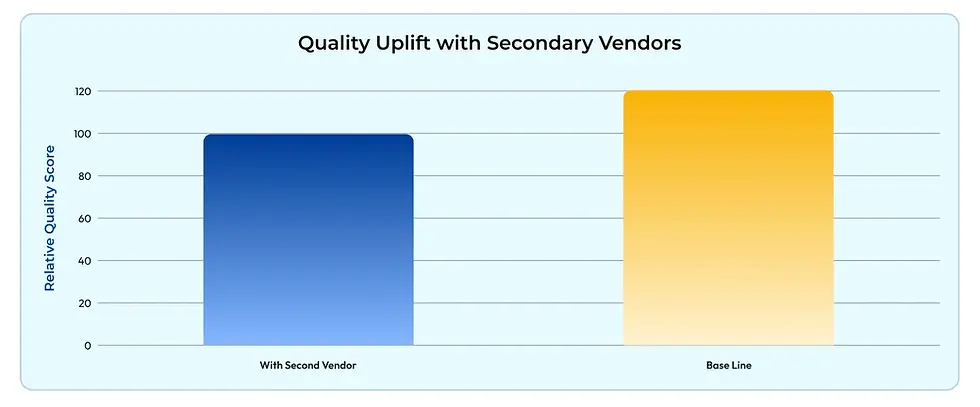
When adding a new supplier for quality reasons, a practical approach is to segment your production by risk level: keep stable, high-volume SKUs with your existing supplier while assigning complex, high-value, or high-visibility formats to a partner with stronger QA infrastructure. This improves quality where it matters most without creating the operational disruption of a full supplier transition.
How We Approach Quality at Kumar Printers?
Over 60 years of supplying packaging to the pharmaceutical industry and to global brands including P&G, Gillette, Nestle, Diageo, Beam Suntory, and Lotte, we have seen the full range of quality challenges that packaging buyers encounter. The problems are rarely unique. What differs is how systematically they are approached.
Our quality process is built around three commitments.
We work with clients to formally document their packaging and printing specifications before production begins, so both teams have a shared, written standard to work from rather than a verbal understanding that degrades over time and across personnel changes.
Our internal production process incorporates raw material testing before printing begins, quality checks at each stage of the production workflow, and a final batch approval checkpoint before anything leaves the facility. Our in-house quality control laboratory carries out all testing, and every supply is accompanied by a certificate of analysis that documents compliance against each specified parameter.
When a quality issue arises, we engage in root cause analysis and provide a formal CAPA, not a workaround. Our goal in every case is a permanent fix built into the process, not a reassurance that the next batch will be checked more carefully.
If you are dealing with a recurring quality issue, whether functional or aesthetic, and have not been able to find a lasting resolution, reach out to us. We are genuinely happy to look at the problem, identify the root cause, and suggest a practical path to eliminating it.
Get in touch at kppl@kumarprinters.com or visit www.kumarprinters.com


Comments