
Am I Spending More on Packaging Than I Should?
Updated: Jul 24
Rising input costs, fragmented supply chains, and legacy packaging decisions often leave companies unknowingly overspending on their packaging. Reducing packaging costs, however, can be a simple process which can help achieve considerable savings, in the range of 10-20% of a packaging budget.
In our user-friendly action plan, we provide an overview of the main components and drivers of packaging costs and how these can be optimised.
Let's start with the basics.
Any paperboard packaging has three main cost elements:
1. Raw materials cost
They normally comprise paper, ink, coating, various films and foils and adhesive. Paper is typically the largest component of the total cost of raw materials.
2. Production process costs
These are the costs of production, normally broken down into press (printing). post press (die cutting, folding, etc.) and manual work (box making, etc.).
3. Freight and logistics costs
If you are purchasing your packaging locally or from within the same country, the cost of storage and transportation may be a small fraction of the total packaging cost. If you are importing, these costs can sometimes add up to almost 50% of your landed price, and hence it's worth considering how to optimise these.
While the ratio of each of these costs remains relatively similar for different products within a category of paperboard packaging (folding cartons, Corrugated/ litho-laminated cartons and rigid boxes), they can vary between each category.
At Kumar Printers, we provide end-to-end packaging solutions, managing everything from design and production to printing and final supply, tailored to meet the specific needs of B2B businesses, and are able to provide cost optimisation options for each aspect of the packaging production process.
Action Plan for Optimising Packaging Costs
Now that we have a high-level overview of our costs, let us take a deep dive into our action plan for optimising these costs:
Cost comparison across suppliers
Right-sizing & Light-weighting
Freight and logistics optimisation
Cost and quantity optimisation
How can Kumar Printers help you?
Step 1: Supplier Cost Comparison
The simplest way to identify cost savings on packaging is to reach out to new suppliers and request quotes for your packs.
Different suppliers have access to varied raw material supply chains, use different technologies for converting and may thus provide very different quotations for the same product.
For example, a packaging company that uses offset printing will be more cost-effective for larger quantities, while a printer utilising a digital press may be cheaper for smaller run jobs.
Similarly, a packaging manufacturer based in a country that relies on imported paper such as the United Kingdom, France or Germany would have very different raw material costs compared to a packaging supplier based in the USA, China or India, where paper production is a large industry.
Take some time to source quotes from suppliers in different geographies and those with different technologies at their disposal, so that you have fresh pricing options to compare. Most suppliers offer free quotations and only need your product specifications to process a quote.
Consider starting the process with your least complex or highest volume packs, as these will offer the most scope for cost savings with the lowest risk.
This process can unlock opportunities for cost reduction and supply chain de-risking without making any changes to the packaging itself.
Case Study: Pros and Cons of Digital and Offset Printing
Offset and Digital are two of the most commonly used technologies for packaging printing. They are considered broadly equal in terms of quality of print; there are differences in unit economics due to variations in machine setup and maximum speeds.
Overall, Digital Printing is a better option for newer brands that need greater flexibility and lower costs for smaller orders, while larger brands that need larger quantities of packaging will find offset printing to be more cost-effective.

For more information on the relative advantages and disadvantages of digital vs offset printing, read our detailed blog post.
Step 2: Right-sizing & Light-weighting
Take a second look at your currently in-use cartons and boxes, keeping in mind the size, weight and fragility of your products.
Well-designed packaging needs to fulfil 2 basic requirements:
Protection: Packaging should keep the main product/ primary packaging safe and secure through the entire supply chain journey.
Information: The pack should be large enough for the printed product information to be clear and legible.
Once these requirements are met, any further increases to pack size or material thickness do not add any additional value, only cost.
Since raw material cost makes up anywhere from 60-80% of a carton's costs, optimising carton size (right-sizing) and paperboard thickness (light-weighting), if done correctly, can yield immediate and substantial cost savings.
Pro Tip

Step 3: Freight and Logistics Optimisation
For those companies importing their packaging or sourcing from a distant location, it may be worth exploring in detail how to best optimise freight costs. If your supplier is quoting a delivered/ landed rate to you, feel free to ask for an ex-works price and source a separate quotation for the transportation to your factory.
If there are any savings to be unlocked by organising your own pickup, this is an easy way to spot them.
Also, consider whether palletisation is strictly necessary for transportation via sea. It may be cheaper to receive material without palletisation and then palletise at your factory or at the receiving port (or not at all). This can enable you to fit 20% more material into a container and has a negligible impact on product safety during transit by sea.
Lastly, review the design of the packaging itself. Is it suitable for optimal long-distance freight costs?
Consider switching from conventional rigid boxes to a collapsible rigid box format, or even consider packing smaller boxes into larger ones.

Step 4: Cost - Quantity Optimisation
Many companies prefer to source smaller batches of packaging to optimise for storage space and to achieve greater flexibility in their product mix. What is not intuitively understood by many packaging buyers, however, is the cost savings that can be unlocked by increasing the quantity ordered.
Consider the case study below, where we have taken a rigid box and calculated production and freight costs for quantities from 1000 pieces all the way up to 200,000 pieces.
These are real but simplified prices (in USD) that show the relationship between quantity and cost.
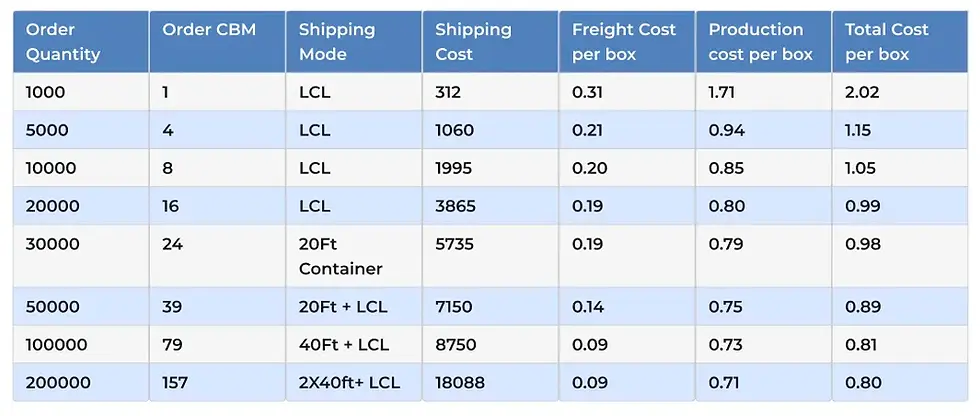
As you can see, the biggest drop in price is unlocked by increasing the order size from just 1000 to 5000. Further increases in order size slowly and steadily reduce the price further.
To understand the inverse relation between order size and unit price, consider the following factors:
Production fixed costs - These costs can be related to items and tools like cutting dies, foiling blocks and printing plates or can be associated with machine setup times.
Logistics fixed costs: Certain international logistics charges like customer clearance, document submission, etc., are fixed and chargeable regardless of the size of the shipment.
Logistics variable costs: As the size of a shipment increases, the cost per CBM or KG normally reduces. If the cost of one CBM of cargo is 100X on a less-than-container-load (LCL) basis, the per CBM cost after booking a 20-foot container is 70X, and the per CBM cost for a 40-foot container is 40X.
How can Kumar Printers help you?
At Kumar Printers, we understand that most manufacturing industries are under increasing cost pressures, with uncertain supply chains and inflation eating into margins for businesses around the world.
In this context, any cost savings in a major spend category can translate into a competitive advantage for your business.
For all our export customers, we aim to help you reduce your packaging spend by 15-20%, even after including freight costs.
Our cost reduction strategy has the following elements:
A constant focus on efficient procurement, production and logistics ensures that we can offer competitive rates for your current products without any changes to specifications.
For customers who can collaborate with our product design teams and are open to incorporating their suggested changes into their packs, these cost savings can be increased further.
Additionally, to ensure full transparency on our pricing, we are happy to offer prices at various quantity tiers and in terms as per your preference (Ex Works, FOB, DDU, DDP), so that you can compare various options and pick the one that suits you best.
Reach out to us today for a free quote and let us discuss how we can help you optimise your packaging budget.


Comments